
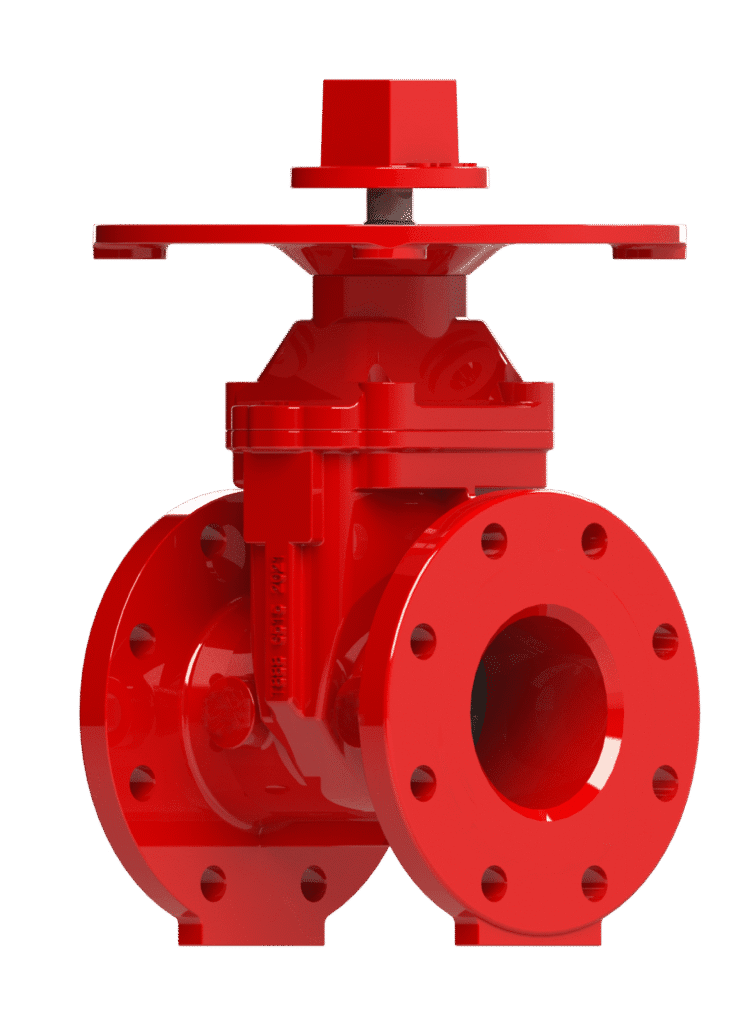
Resilient Seat, Non Rising Stem Post Indicator Gate Valve Model 201 PIV
The Century Model 201 is a Non-Rising Stem (NRS) gate valve specifically configured to be used underground applications. While its core design confines all stem movement within the valve body, this model features a top flange plate designed to directly accept a mechanical indicator post. The valve utilizes a fully EPDM-encapsulated ductile iron wedge for a bubble-tight seal and is coated with fusion-bonded epoxy for superior corrosion resistance. It serves as the foundational control component in a complete Post Indicator Valve (PIV) assembly.
Key Features: UL Listed, FM Approved, NSF/ANSI/CAN 61, NSF/ANSI 372 Top plate for Indicator Post or Valve Box, Resilient Seated Wedge (EPDM), Non-Rising Stem Design, Fusion Bonded Epoxy Coating (AWWA C550).
Primary Use: The foundational valve component for underground fire mains that require above-ground status indication via a vertical indicator post or Valve Box.
Widely used across various sectors, including: Commercial Real Estate, Industrial Parks, Municipal Water Systems, University Campuses, and Hospital Facilities.
Information
Proper Storage:
If storage is required before installation, position the valve with the Post Flange (Item 18) oriented upward. Prior to installation, re-inspect the unit to verify its condition has not changed.
Inspect for Shipping Damage:
Visually inspect the entire valve assembly for any cracks, dents, or other damage sustained during transit.
Subsequently, operate the Wrench Nut (Item 12) through its full range of motion in both directions to confirm smooth mechanical action and internal integrity.
Verify External Hardware:
Confirm that all bolts, plugs, and other external hardware are secure and have not loosened during shipment.
Final Valve Positioning and Verification:
- Determine Required State: Consult system engineering plans to determine the final operational state. For active fire protection systems, this is typically the fully OPEN position.
- Set Internal Gate Position: Use the operating wrench to move the internal Wedge (Item 2) to the designated position until it gently stops.
- Verify Visual Indicator: Confirm the visual indicator plate on the post accurately displays the corresponding status: OPEN or SHUT. The displayed status must match the internal gate’s position.
Handling Notice:
- Handle with care at all times to protect sealing surfaces, the indicator mechanism, and external components.
- Lift only by the valve Body (Item 1).
- Never lift, carry, or support the valve by the Stem (Item 3) or the Wrench Nut (Item 12). Applying force to these components can damage the gear operator and compromise valve alignment.
Verify Valve Specifications:
Before installation, confirm that the valve’s model, size, pressure rating, and material specifications match the requirements listed in the system engineering plans. Installing an incorrect valve can lead to system failure.
Prepare Mating Surfaces:
Thoroughly clean the valve flanges and both mating pipe flanges. Ensure all surfaces are completely free of dirt, rust, debris, and any foreign materials that could compromise the integrity of the seal.
Select and Inspect Gasket:
Use only gaskets rated for the system’s maximum operating pressure and temperature. Before installation, visually inspect the Gasket (Item 16) to confirm it is free from any defects, tears, or damage. Do not use a damaged gasket.
Align Flanges:
Position the valve between the pipe flanges, ensuring the flange faces are parallel and concentric before making contact with the Gasket (Item 16).
Caution: Misalignment, especially when installing into existing pipework, can impose dangerous stress on the valve Body (Item 1) and lead to damage or failure.
Install and Tighten Bolting:
Install all specified bolts and nuts. Tighten the bolts incrementally using a star or crisscross pattern to ensure uniform pressure on the gasket. Repeat the tightening sequence until all bolts have reached their required torque.
Perform Post-Installation Cleaning:
After completing the mechanical installation and before pressurizing the system, thoroughly flush and clean the interior of the valve and piping to remove all installation debris and foreign matter.
Opening Procedure:
To open the valve, rotate the Post Indicator’s operating wrench counter-clockwise until it reaches a firm mechanical stop. No additional force is required. Once the valve is fully open and the indicator reads ‘OPEN’, it is advantageous to turn the operating wrench clockwise approximately one-half turn. This practice prevents thermal binding and eases future operation.
Closing Procedure:
To close the valve, rotate the operating wrench clockwise until it reaches a firm mechanical stop and the indicator reads ‘SHUT’.
Operational and Safety Notices:
- Prohibited Practices: Never use extension bars or other leverage devices on the operating wrench. Applying excessive force can damage the post mechanism, operating Stem (Item 3), and internal valve components.
- On/Off Service Only: This valve is designed exclusively for on/off service and must be used in either the fully ‘OPEN’ or fully closed ‘SHUT’ position. Do not use this valve for regulating or throttling flow, as this will cause premature wear and damage to the Wedge (Item 2) and Seat Ring (Item 8).
- Thermal Binding Effects: Be aware that significant temperature changes can affect the force required to operate the valve.
- A valve closed while the system is hot may become difficult to open after it cools due to thermal contraction.
- Conversely, a valve closed at ambient temperature may become tight if the fluid temperature increases, causing thermal expansion of the internal components.
- Personal Protective Equipment: Operators must wear suitable hand protection when operating the valve in environments with extreme ambient temperatures.
Pre-Maintenance Safety Requirements:
Before commencing any maintenance activity, the following safety prerequisites must be met:
- System Depressurization: The valve and associated piping must be fully depressurized to zero pressure and allowed to return to ambient temperature.
- Risk Assessment: A comprehensive risk assessment and method statement must be completed. This assessment must evaluate all potential hazards, including scenarios where the valve’s operational limits might be exceeded.
- Tool and Equipment Selection: Maintenance personnel must use only correct, well-maintained tools and equipment suitable for the task.
- Hot Work Permit: The use of tools that could generate sparks is strictly prohibited in the presence of any hazardous or potentially explosive atmosphere. A hot work permit is required, and the work area must be certified free of flammable gases, vapors, and combustible dust before such tools are used.
Gland Packing Adjustment:
If a leak is observed from the Stem (Item 3) seal, or as part of periodic maintenance, the Gland (Item 6) packing may require adjustment.
- Procedure: Using the appropriate wrench, tighten the Disc nut (Item 7) evenly and gradually in a clockwise direction.
- Completion: Continue tightening in small increments until either the leakage stops or a significant increase in resistance is felt.
- Warning: Do not over-tighten, as this can damage the packing and score the Stem (Item 3).
Corrosion and Wall Thickness Inspection:
In systems where corrosion or erosion is a known risk, a periodic inspection of the valve’s wall thickness is mandatory.
- Inspection Method: This check requires either removing the valve from the pipeline or removing the Bonnet (Item 4) while the system is fully depressurized.
- Replacement Criteria: Measure the wall thickness of the valve Body (Item 1) and Bonnet (Item 4). If measurements indicate a material loss of 25% or more from the original specified thickness, the entire valve must be removed from service and replaced immediately.
By following these maintenance steps, your valve will remain in proper working condition and ready to provide service when needed most.
Please contact us at sales@centuryvalves.com for all your valve needs.
| Model 201 PIV | ||||
|---|---|---|---|---|
| Resilient Seat, Non Rising Stem Post Indicator Gate Valve | ||||
| Connections | Flange | Mechanical Joint | Grooved | |
| Sizes | 2″, 3″, 4″, 6″, 8″, 10″, 12″, 14″, 16″, 18″, 20″, 24″ | |||
| Approvals | UL Listed, FM Approved, NSF/ANSI/CAN 61, NSF/ANSI 372 | |||
| Design Standard | AWWA C515-20 | MSS-SP-70 | MSS-SP-128 | BS5163 |
| Flange Dimensions | ANSI B16.1 Class 125 Flat Face | Other Drillings Upon Request | ||
| Coating | Fusion Bond Epoxy interior and exterior to suit AWWA C550 Standard | |||
| Compatibility | PIV Valve compatible with Industry standard vertical indicator post | |||
| Pressure Rating | 2″ ~ 12″ @ 300psi | 14″ ~ 18″ @ 250psi | 20″ ~ 24″ @ 200psi | |
| Temperature | -10°C to 120°C | 14°F to 248°F | ||
Certifications




We are ready to assist you
We are ready to assist you / Have questions or need support? Our team is ready to assist with your next project.